
Predictive Looking Errors and Event Segmentation
Research Question
Can we derive continuous measures of prediction error based on gaze patterns? How would they be related to event comprehension structures
Overview
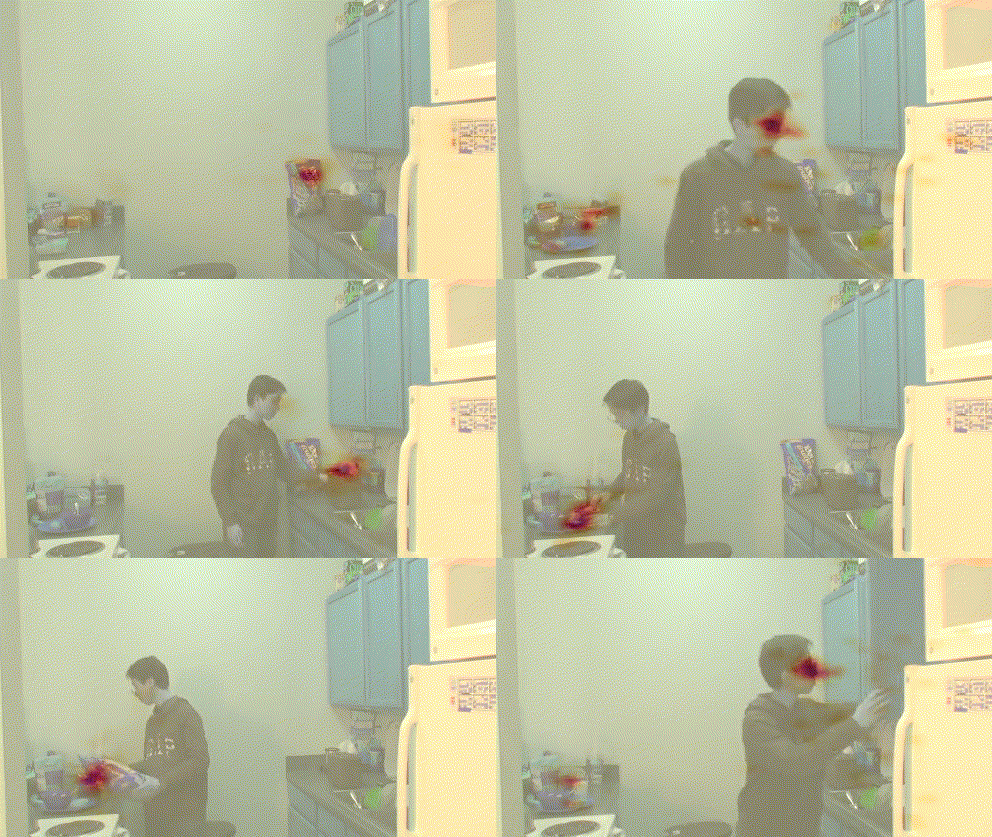
This project investigates the relationship between predictive looking (anticipatory eye movements toward future action locations) and event segmentation (how people divide continuous experience into discrete events). Using high-frequency eye-tracking during naturalistic movie viewing, I show that viewers anticipate actors’ hand movements up to 9 seconds in advance, and that prediction failures align closely with event boundaries.
Theoretical Motivation
Event segmentation theory posits that people continuously update mental models of “what is happening now” during perception. When these models fail to predict incoming information, an event boundary is perceived. This project tests whether:
- Viewers make predictive eye movements during everyday activities
- These predictions sometimes fail (predictive looking errors)
- Prediction failures align with event boundaries
- Gaze-based prediction error correlates with computational model error
Methodology
Participants and Stimuli
- Participants watched videos of everyday activities (e.g., making breakfast, assembling objects, social interactions)
- Manual event segmentation collected separately
Eye-Tracking Protocol
- High-frequency eye-tracking (1000 Hz)
- Gaze mapped to video frame coordinates
- Fixations classified as on-target (actor’s hands/objects) or off-target
Gaze-to-Grid Pipeline (gaze2grid.py)
A key methodological contribution is the gaze2grid pipeline, which converts raw gaze coordinates into spatial density grids for analysis:
# Pseudocode for gaze2grid pipeline
def gaze2grid(gaze_data, grid_size=10):
    """
    Convert raw gaze coordinates to spatial density grid

    Parameters:
    - gaze_data: Timeseries of (x, y) gaze coordinates
    - grid_size: Number of grid cells per dimension

    Returns:
    - density_grid: Grid of gaze density values
    """
    # 1. Normalize gaze coordinates to [0, 1]
    # 2. Bin coordinates into grid cells
    # 3. Compute density per cell
    # 4. Return density matrix
This pipeline enables:
- Spatial analysis of gaze patterns
- Comparison with model predictions
- Quantification of prediction error
Predictive Looking Analysis
Predictive looking was operationalized as:
- Identify actor’s hand position at time
t(currentlocation) - Check if viewer’s gaze at time
t-Δtcan predict the actor’s hand position at timet - Compute lead time: How far in advance gaze arrives at future location
Predictive looking errors occur when:
- Gaze anticipates location A, but actor moves to location B
- Quantified as spatial distance between predicted and actual locations
Statistical Analysis
Mixed-effects models tested:
- Relationship between prediction error and event boundary probability
- Individual differences in predictive looking ability
- Comparison with computational model error (Predictive, Associative, and Retrospective – PAR model)
Key Findings
1. Viewers Anticipate Actions Up to 9 Seconds in Advance
- Gaze moves to future action locations before the actor’s hands arrive
- Median lead time: 2-3 seconds
- Some viewers anticipate up to 9 seconds ahead
2. Prediction Errors Align with Event Boundaries
- When gaze predictions fail, event boundary probability increases significantly
3. Gaze-Based Error Mirrors Computational Model Error
- Prediction errors from gaze data correlate with errors from SEM computational model
- Suggests gaze-based error is a valid proxy for internal model error
4. Individual Differences in Predictive Looking
- Viewers with higher boundary agreement show more reliable predictive looking
- Suggests predictive looking is related to event segmentation ability
Interpretation
These findings support the hypothesis that event segmentation is driven by prediction failure, not passive perception. Specifically:
- Viewers actively predict future action locations during naturalistic perception
- Prediction errors trigger event boundaries: When predictions fail, viewers perceive a boundary
- Gaze as a window into cognitive state: Eye movements reveal the content and success of internal predictions
Repository Contents
The Predictive_Looking repository includes:
Key Files:
gaze2grid.py: Converts raw eye-tracking data to spatial density gridspredictive_looking_analysis.R: Mixed-effects models and statistical testsvisualization.R: Generate gaze density maps and timecourse plotsoutputs/: Example figures including the gaze heatmap shown above
Pipeline:
- Preprocessing: Clean eye-tracking data (blink removal, interpolation)
- Gaze2Grid: Convert gaze to spatial grids
- Predictive Looking Detection: Identify anticipatory fixations
- Error Calculation: Quantify prediction failures
- Statistical Analysis: Mixed-effects models in R
- Visualization: Generate plots and heatmaps
Ongoing Extensions
- Incremental vs. Global Updating: Do prediction errors trigger incremental model updates or global restructuring?
- fMRI Integration: Neural correlates of prediction error and event boundaries
- Hierarchical Models: Multiple levels of prediction (low-level actions → high-level goals)
Publication
Predictive Looking and Predictive Looking Errors in Everyday Activities Journal of Experimental Psychology: General (October 2025)
Keywords: Eye-tracking, Predictive Processing, Event Segmentation, Anticipatory Eye Movements, Prediction Error, Naturalistic Perception
Code & Resources
Predictive_Looking
Codes for predictive looking analysis including gaze2grid pipeline
Publications
Predictive Looking and Predictive Looking Errors in Everyday Activities
Journal of Experimental Psychology: General , 2025-10 [paper]
Download