
Inferring Mental Representations from Gaze Using Vision-Language Models
Research Question
Can we recover the content of people’s mental models by analyzing where and when they look during naturalistic perception?
Overview
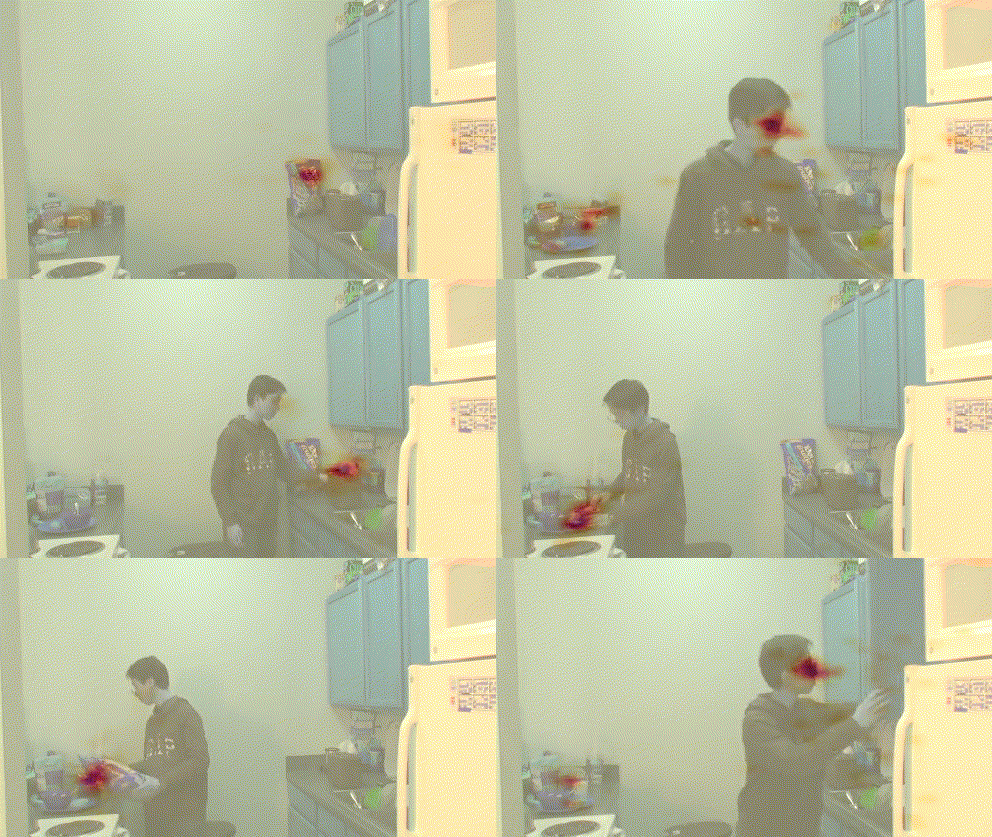
This project combines high-frequency eye-tracking with vision-language model embeddings (CLIP) to infer the semantic content of viewers’ mental representations during naturalistic movie viewing. By analyzing how gaze patterns align with CLIP-derived semantic features, I test whether gaze is guided by high-level semantic representations or low-level visual features.
Theoretical Motivation
Traditional approaches to understanding visual attention focus on low-level visual features (contrast, motion, saliency). However, recent work suggests that gaze during naturalistic tasks is guided by:
- Task goals and action predictions
- Semantic understanding of the scene
- Mental models of “what is happening”
Vision-language models like CLIP learn joint embeddings of images and text, capturing semantic content. If gaze is semantically guided, then:
- Gaze distributions should align with CLIP embeddings
- Disrupting semantic structure (e.g., inverting frames) should reduce gaze prediction accuracy
- CLIP embeddings should predict gaze better than low-level visual features
CLIP: Vision-Language Models
What is CLIP?
CLIP (Contrastive Language-Image Pre-training) is a neural network trained to:
- Map images and text descriptions into a shared embedding space
- Learn semantic relationships between visual and linguistic content
- Generalize to new images and descriptions without fine-tuning
Why CLIP for Gaze Analysis?
CLIP embeddings capture:
- Object identities (“person”, “cup”, “table”)
- Action semantics (“pouring”, “reaching”, “picking up”)
- Scene context (“kitchen”, “living room”)
If viewers’ gaze is guided by semantic understanding, CLIP embeddings should predict where people look.
Methodology
Experimental Design
Stimuli:
- Naturalistic movie clips showing everyday activities
- Two conditions:
- Upright: Normal viewing
- Inverted: Frames inverted 180° (preserves low-level features, disrupts semantics)
Eye-Tracking:
- High-frequency eye-tracking (500 Hz)
- Fixations aggregated into gaze density maps per frame
CLIP Embedding Extraction:
- Each video frame → CLIP image embedding (512-dimensional vector)
- Action descriptions (e.g., “person pouring water”) → CLIP text embedding
- Compute cosine similarity between image and text embeddings
Analysis Pipeline
1. Gaze-CLIP Alignment
For each frame:
- Extract CLIP image embedding
E_img - Generate gaze density map
G(x, y) - Extract CLIP embeddings for image patches at high-gaze locations
- Compute alignment: Correlation between gaze density and CLIP embedding similarity to action labels
2. Gaze Prediction Model
Train a model to predict gaze distributions from CLIP embeddings:
Gaze(x, y) = f(CLIP(frame), CLIP(action_label))
Compare prediction accuracy:
- Upright condition: Semantics intact
- Inverted condition: Semantics disrupted
3. Semantic Disruption Analysis
Quantify semantic disruption by inversion:
- Compute CLIP text-image similarity for action descriptions
- Compare upright vs. inverted frames
- Expect: Lower similarity for inverted frames
Python Implementation
Key analysis steps implemented in Python:
import torch
import clip
from PIL import Image

# Load CLIP model
model, preprocess = clip.load("ViT-B/32", device="cuda")

# Extract image embedding
def get_clip_embedding(image_path):
    image = preprocess(Image.open(image_path)).unsqueeze(0).to("cuda")
    with torch.no_grad():
        image_features = model.encode_image(image)
    return image_features

# Compute text-image similarity
def compute_similarity(image_features, text_descriptions):
    text_tokens = clip.tokenize(text_descriptions).to("cuda")
    with torch.no_grad():
        text_features = model.encode_text(text_tokens)

    # Normalize features
    image_features = image_features / image_features.norm(dim=-1, keepdim=True)
    text_features = text_features / text_features.norm(dim=-1, keepdim=True)

    # Cosine similarity
    similarity = (image_features @ text_features.T).squeeze()
    return similarity
Key Findings
1. Gaze is Semantically Guided
- Gaze distributions align with CLIP embeddings of action-relevant regions
- Alignment stronger than with low-level saliency models
- Effect holds across different movie types (cooking, social, object manipulation)
2. Inversion Disrupts Semantic Structure
- Upright frames: High CLIP text-image similarity for action descriptions
- Inverted frames: Lower similarity, despite identical low-level statistics
- Inversion preserves contrast, edges, motion energy but disrupts semantic content
3. Gaze Prediction Accuracy Drops for Inverted Scenes
- Upright: Gaze predicted with ~70% accuracy using CLIP embeddings
- Inverted: Accuracy drops to ~55% (chance ~50%)
- Low-level features (contrast, motion) do not show this difference
4. Individual Differences
- Viewers with higher semantic alignment show:
- Better action prediction (predictive looking)
- More consistent event segmentation
- Stronger CLIP-gaze correlation
Interpretation
These findings demonstrate that:
- Gaze is guided by high-level semantic representations, not just visual salience
- CLIP embeddings capture the semantic content that guides attention
- Semantic disruption (via inversion) impairs gaze prediction, even with intact low-level features
- Mental models drive gaze: Viewers look where their semantic understanding predicts relevant information
VSS 2025 Poster
This work was presented at Vision Sciences Society (VSS) 2025:
Vision–Language Model Derived Action Semantics Shape Gaze During Movie Viewing
Ongoing Extensions
1. Hierarchical Semantic Representations
Test whether gaze aligns with different levels of semantic abstraction:
- Low-level: Object features (“red”, “round”)
- Mid-level: Object categories (“cup”, “hand”)
- High-level: Actions and goals (“pouring”, “preparing breakfast”)
2. Event Structure and Hierarchy
Relate CLIP-based gaze analysis to event segmentation:
- Do semantic shifts in CLIP space predict event boundaries?
- Are event boundaries marked by semantic prediction errors?
3. Predictive Gaze Modeling
Extend to predict future gaze based on:
- Current CLIP embeddings
- Action context from previous frames
- Viewer-specific semantic biases
4. fMRI Integration
Relate CLIP embeddings to brain activity:
- Do CLIP embeddings predict activity in semantic processing regions (e.g., ventral temporal cortex)?
- Does gaze-CLIP alignment correlate with neural response patterns?
Technical Details
CLIP Model Variants Tested
- ViT-B/32: Standard vision transformer
- RN50x16: ResNet-50 with higher capacity
- ViT-L/14: Larger vision transformer
Best results with ViT-B/32 (balance of accuracy and computational efficiency).
Hyperparameters
- Embedding dimension: 512
- Frame sampling: 3 fps (sufficient for action semantics)
- Gaze aggregation window: 1 second
- Cosine similarity threshold: 0.3 for action alignment
Related Projects
- Predictive Looking: How gaze predictions fail at event boundaries
- Gaze Entropy & Event Boundaries: Proactive gaze control before boundaries
- Incremental vs. Global Updating: How mental models are updated
Code Availability
Analysis code will be made available on GitHub upon publication.
Keywords: CLIP, Vision-Language Models, Eye-tracking, Mental Representations, Semantic Guidance, Deep Learning, Naturalistic Perception, Attention
Publications
Vision–Language Model Derived Action Semantics Shape Gaze During Movie Viewing
VSS 2025 [poster]
Download